The San Remo Conference has been rightly described as the "Magna Carta of the Jewish People" grounding its right in international law to reconstitute the Jewish National Home in Palestine.
The following news item from CBN News on 9 July 2010 explains the importance of this Conference and its relevance 91 years later in 2011
You can view the CBN news item here:
http://www.youtube.com/watch?v=ijS8mFP4I1A&feature=youtube_gdata_player
The importance of the San Remo Conference is discussed by Howard Grief at:
http://www.youtube.com/watch?v=SWWvKsrb8u8&feature=related
A summary of the San Remo Conference and its importance in resolving the current conflict can be seen at:
http://www.youtube.com/watch?v=eNgt7Nxb1ms&feature=related
Resolving the Arab - Jewish conflict
Articles by David Singer and archival records retrieved by him calling for and supporting the division of the West Bank and Gaza between Israel, Jordan and Egypt as the key to resolving the 130 years old conflict between Jews and Arabs over the territory once called Palestine.
Tuesday, April 26, 2011
Sunday, April 24, 2011
Return of the Jordanian Option
Asaf Romirowsky's article "Revisiting the Jordanian Option" elicited the following response "Return of the Jordanian Option" on 23 April 2011.
The international community needs to get serious on the issue of sovereignty in the West Bank,East Jerusalem and Gaza.
If the Palestinian Authority is not prepared to get its act together with Hamas and accept sovereignty in the 95% offered to be ceded by Israel (with a land swap of Israeli sovereign territory for that remaining 5%) - then Jordan should be invited to negotiate with Israel on restoring as far as is now possible the status quo that existed at 5 June 1967 within the framework of their 1994 Peace Treaty.
It seems the sensible way to go in an attempt to avoid escalating conflict.
The only thing preventing it happening is the acute embarrassment and loss of face that would be suffered by the United Nations and its member states after pursuing the two-state solution for the last 17 years. Surely by now it must be obvious to them all that such a solution will never be capable of coming to fruition.
If I had to choose between saving Jewish and Arab lives OR eating humble pie - I know which one I would choose.
*************************************************************************************
Return of the Jordanian Option
Because the Palestinian Arabs have perpetually refused to end hostilities with the Jews through accepting a state for themselves in peace next to the Jewish one, some Israeli Knesset officials are revisiting the Jordanian option.
Amid the unrest now sweeping the Middle East, Israeli government and security officials are quietly discussing an unusual strategy that would pass the Palestinians’ political future off to Jordan. With the odds of a negotiated two-state solution at an all-time low, former Defense Minister Moshe Arens, Knesset Member Arieh Eldad, and Knesset Speaker Reuven Rivlin resurrected the “Jordan is Palestine” model for regional peace.
Israeli officials fear that a Palestinian Intifada could break out on both sides of the Jordan River, and they seek to make it as much a Jordanian problem as an Israeli one.
Although anti-Zionist radicals of the sort that frequent Daily Kos, the Huffington Post, and the UK Guardian look upon the Jordanian option with extreme distaste because it means the resolution of the conflict, that is not Israel's problem.
Nor is it mine, of course.
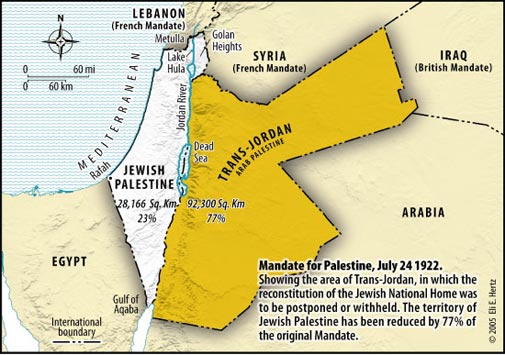
The fact is that Jordan comprises about 77 percent of British mandated Palestine and the Palestinians represent something like 75 percent of the population of that country. This means that Jordan is, essentially, "Palestine."
As a long-time supporter of the two-state solution it is more than a little disappointing that oppressed and occupied Palestinians absolutely refuse to end their oppression and occupation by accepting a state for themselves in peace next to Israel.
It's just very unusual. In the long history of human oppression, I have never heard of any oppressed people who refuse to give up their oppression until their conditions are met.
It's remarkable, in fact.
From early in the twentieth century until today the Palestinians, and before them the Arabs of the British mandate, have never accepted the partition plan and have never accepted a Jewish state on any part of formerly Muslim controlled land. For reasons having to do with extreme, Koranically-sanctioned, hatred toward Jews, as well as the requirements of the Sharia, the Arabs have consistently refused acceptance of Israel as the Jewish state.
As anyone who reads this blog knows my stance is to respect the Palestinians by respecting their decision. Their decision is "no." For almost a hundred years their position has consistently been "no."
No negotiations. No recognition. No peace.
These are the three famous "nos" of Khartoum, issued by the Arab League immediately following the "humiliating" Arab defeat in the 6 Day War, and there is very little, if anything, to indicate that they are not still in effect.
That being the case we need to accept the fact that "no means no." And since "no means no," since the Palestinians have consistently refused to end the conflict via a negotiated settlement, Israel needs to resolve the conflict in a manner that does not depend on a negotiated settlement. One way to do that, the way that I have generally supported, is for Israel to declare its final borders on the western side of the Jordan river and then move the IDF behind those borders.
That represents one potential resolution, but the Jordanian option represents another possibility. Given that its population is three-quarters Palestinian, it makes sense to declare Jordan the Palestinian state, with an annexation of much of the western bank of the river.
At the moment only a relatively small proportion of Israelis see the Jordanian option as viable, but given the circumstances of perpetual Palestinian intransigence and refusal to accept a state for themselves, it's an option that Israel should explore. What's needed is for Israel to come up with the incentives necessary to bring the Jordanian government into agreement.
This will certainly not be easy, but what's there to lose?
Besides, as PLO executive Zuheir Mohsen acknowledged:
Heck, they'd barely even need to modify their flags.
The international community needs to get serious on the issue of sovereignty in the West Bank,East Jerusalem and Gaza.
If the Palestinian Authority is not prepared to get its act together with Hamas and accept sovereignty in the 95% offered to be ceded by Israel (with a land swap of Israeli sovereign territory for that remaining 5%) - then Jordan should be invited to negotiate with Israel on restoring as far as is now possible the status quo that existed at 5 June 1967 within the framework of their 1994 Peace Treaty.
It seems the sensible way to go in an attempt to avoid escalating conflict.
The only thing preventing it happening is the acute embarrassment and loss of face that would be suffered by the United Nations and its member states after pursuing the two-state solution for the last 17 years. Surely by now it must be obvious to them all that such a solution will never be capable of coming to fruition.
If I had to choose between saving Jewish and Arab lives OR eating humble pie - I know which one I would choose.
*************************************************************************************
Return of the Jordanian Option
Because the Palestinian Arabs have perpetually refused to end hostilities with the Jews through accepting a state for themselves in peace next to the Jewish one, some Israeli Knesset officials are revisiting the Jordanian option.
Amid the unrest now sweeping the Middle East, Israeli government and security officials are quietly discussing an unusual strategy that would pass the Palestinians’ political future off to Jordan. With the odds of a negotiated two-state solution at an all-time low, former Defense Minister Moshe Arens, Knesset Member Arieh Eldad, and Knesset Speaker Reuven Rivlin resurrected the “Jordan is Palestine” model for regional peace.
Israeli officials fear that a Palestinian Intifada could break out on both sides of the Jordan River, and they seek to make it as much a Jordanian problem as an Israeli one.
Although anti-Zionist radicals of the sort that frequent Daily Kos, the Huffington Post, and the UK Guardian look upon the Jordanian option with extreme distaste because it means the resolution of the conflict, that is not Israel's problem.
Nor is it mine, of course.
The fact is that Jordan comprises about 77 percent of British mandated Palestine and the Palestinians represent something like 75 percent of the population of that country. This means that Jordan is, essentially, "Palestine."
As a long-time supporter of the two-state solution it is more than a little disappointing that oppressed and occupied Palestinians absolutely refuse to end their oppression and occupation by accepting a state for themselves in peace next to Israel.
It's just very unusual. In the long history of human oppression, I have never heard of any oppressed people who refuse to give up their oppression until their conditions are met.
It's remarkable, in fact.
From early in the twentieth century until today the Palestinians, and before them the Arabs of the British mandate, have never accepted the partition plan and have never accepted a Jewish state on any part of formerly Muslim controlled land. For reasons having to do with extreme, Koranically-sanctioned, hatred toward Jews, as well as the requirements of the Sharia, the Arabs have consistently refused acceptance of Israel as the Jewish state.
As anyone who reads this blog knows my stance is to respect the Palestinians by respecting their decision. Their decision is "no." For almost a hundred years their position has consistently been "no."
No negotiations. No recognition. No peace.
These are the three famous "nos" of Khartoum, issued by the Arab League immediately following the "humiliating" Arab defeat in the 6 Day War, and there is very little, if anything, to indicate that they are not still in effect.
That being the case we need to accept the fact that "no means no." And since "no means no," since the Palestinians have consistently refused to end the conflict via a negotiated settlement, Israel needs to resolve the conflict in a manner that does not depend on a negotiated settlement. One way to do that, the way that I have generally supported, is for Israel to declare its final borders on the western side of the Jordan river and then move the IDF behind those borders.
That represents one potential resolution, but the Jordanian option represents another possibility. Given that its population is three-quarters Palestinian, it makes sense to declare Jordan the Palestinian state, with an annexation of much of the western bank of the river.
At the moment only a relatively small proportion of Israelis see the Jordanian option as viable, but given the circumstances of perpetual Palestinian intransigence and refusal to accept a state for themselves, it's an option that Israel should explore. What's needed is for Israel to come up with the incentives necessary to bring the Jordanian government into agreement.
This will certainly not be easy, but what's there to lose?
Besides, as PLO executive Zuheir Mohsen acknowledged:
"The Palestinian people does not exist. The creation of a Palestinian state is only a means for continuing our struggle against the state of Israel for our Arab unity. In reality today there is no difference between Jordanians, Palestinians, Syrians and Lebanese. Only for political and tactical reasons do we speak today about the existence of a Palestinian people, since Arab national interests demand that we posit the existence of a distinct Palestinian people to oppose Zionism.
For tactical reasons, Jordan, which is a sovereign state with defined borders, cannot raise claims to Haifa and Jaffa, while as a Palestinian, I can undoubtedly demand Haifa, Jaffa, Beer-Sheva and Jerusalem. However, the moment we reclaim our right to all of Palestine, we will not wait even a minute to unite Palestine and Jordan."
Heck, they'd barely even need to modify their flags.
Saturday, April 23, 2011
Revisiting the Jordan Option
The following article appeared on Y Net on 23 April 2011.
Jordan's involvement in resolving the issue of sovereignty in the West Bank and East Jerusalem continues to be more likely as the two-state solution continues to go nowhere.
***********************************************************************************
Revisiting the Jordan option
Op-ed: With hopes fading for two-state solution, ‘Jordan is Palestine’ option may be best alternative
Asaf Romirowsky
Published: 04.23.11, 14:21 / Israel Opinion
Amid the unrest now sweeping the Middle East, Israeli government and security officials are quietly discussing an unusual strategy that would pass the Palestinians’ political future off to Jordan. With the odds of a negotiated two-state solution at an all-time low, former Defense Minister Moshe Arens, Knesset Member Arieh Eldad, and Knesset Speaker Reuven Rivlin resurrected the “Jordan is Palestine” model for regional peace.
Israeli officials fear that a Palestinian Intifada could break out on both sides of the Jordan River, and they seek to make it as much a Jordanian problem as an Israeli one.
In February, Human Rights Watch, the world’s self-proclaimed defender of minority rights, produced a 60-page report entitled, “Stateless Again: Palestinian-Origin Jordanians Deprived of their Nationality.” The paper details how Jordan deprives its Palestinian citizens of West Bank origins their basic rights, such education and healthcare. The report received scant attention back then. But the problem of Jordanian Palestinians, amidst growing unrest in the Hashemite Kingdom, has put the issue back on the front burner.
Israeli analysts worry that if the Jordanian government is to become more representative, it is possible that the country’s 72% Palestinian population could effectively take control. Jordan, in effect, could become “Palestine.”
The notion of a Palestinian controlled polity in Jordan is not new. From the war of Israeli independence in 1948 through the Six-Day War in 1967, Israeli politicians on the Left and Right advanced a policy of “Jordan is Palestine.” While defending Israel from Arab aggression, they proposed that Jordan become the Palestinian homeland. Israeli officials proposed various scenarios for a Jordanian-Palestinian confederation that fused the East Bank and West Bank of the Jordan River under one administration.
However, it is not as simple as that. Dan Schueftan, author of A Jordanian Option, correctly noted in 1986 that such an arrangement would be dependent on Israeli-Jordanian relations and how the two parties view potential threats from the Palestinian populations in their midst.
Inseparable security needs
To be sure, in the years after the Six-Day War, the Jordanian monarchy was wary of the Palestinians. Palestine Liberation Organization leader Yasser Arafat challenged the sovereignty of the country in 1970. After that, the kingdom had blocked the flow of Palestinians from the West Bank into the East Bank in order to preserve the kingdom’s Hashemite political structure. To a certain extent, the Jordanians renounced all claims to the West Bank in 1988, backed the creation of the Palestinian Authority in the early 1990s, and then made peace with Israel in 1994 in an attempt to prevent further flooding of Palestinians into their country.
To a certain extent Jerusalem has long looked to the Hashemite monarchy to maintain stability and security on both sides of the river. Both Amman and Jerusalem, in fact, recognize that their security needs are inseparable. Jordan has benefited from the periods of relative quiet and prosperity in Israel. Accordingly, Jordanian security forces have been increasingly involved in the West Bank, where they conduct joint training sessions with Palestinian forces. It has been a win-win-win situation for Jordan, Israel and the Palestinians.
The problem now is that Jordan’s traditional power centers are unhappy with the rise of Palestinian influence in the country. Tribal leaders resent Jordan’s Queen Rania, born in Kuwait to a family with roots in the West Bank, for her vocal advocacy of the Palestinian cause. In fact, 36 tribal leaders recently published their objections to Rania’s position, fearing that it will accelerate a slow Palestinian takeover of the kingdom.
With hopes fading for a two-state solution to the Palestinian-Israeli conflict, this seemingly far-flung notion may become the last, best option. The problem is that it could embolden Palestinian radical groups, as well as the Muslim Brotherhood, which derive much of their power from disillusioned Palestinians in the West and East Banks. With the rise of such groups in Jordan, the peace agreement between Amman and Jerusalem would be in peril.
Nevertheless, as uncomfortable as it might be for Palestinians, Israelis and Jordanians to admit, the Jordanian option might be the best one they have.
Asaf Romirowsky is an adjunct scholar at the Foundation for Defense of Democracies and a former liaison officer from the Israeli Defense Forces to the Hashemite Kingdom of Jordan
Jordan's involvement in resolving the issue of sovereignty in the West Bank and East Jerusalem continues to be more likely as the two-state solution continues to go nowhere.
***********************************************************************************
Revisiting the Jordan option
Op-ed: With hopes fading for two-state solution, ‘Jordan is Palestine’ option may be best alternative
Asaf Romirowsky
Published: 04.23.11, 14:21 / Israel Opinion
Amid the unrest now sweeping the Middle East, Israeli government and security officials are quietly discussing an unusual strategy that would pass the Palestinians’ political future off to Jordan. With the odds of a negotiated two-state solution at an all-time low, former Defense Minister Moshe Arens, Knesset Member Arieh Eldad, and Knesset Speaker Reuven Rivlin resurrected the “Jordan is Palestine” model for regional peace.
Israeli officials fear that a Palestinian Intifada could break out on both sides of the Jordan River, and they seek to make it as much a Jordanian problem as an Israeli one.
In February, Human Rights Watch, the world’s self-proclaimed defender of minority rights, produced a 60-page report entitled, “Stateless Again: Palestinian-Origin Jordanians Deprived of their Nationality.” The paper details how Jordan deprives its Palestinian citizens of West Bank origins their basic rights, such education and healthcare. The report received scant attention back then. But the problem of Jordanian Palestinians, amidst growing unrest in the Hashemite Kingdom, has put the issue back on the front burner.
Israeli analysts worry that if the Jordanian government is to become more representative, it is possible that the country’s 72% Palestinian population could effectively take control. Jordan, in effect, could become “Palestine.”
The notion of a Palestinian controlled polity in Jordan is not new. From the war of Israeli independence in 1948 through the Six-Day War in 1967, Israeli politicians on the Left and Right advanced a policy of “Jordan is Palestine.” While defending Israel from Arab aggression, they proposed that Jordan become the Palestinian homeland. Israeli officials proposed various scenarios for a Jordanian-Palestinian confederation that fused the East Bank and West Bank of the Jordan River under one administration.
However, it is not as simple as that. Dan Schueftan, author of A Jordanian Option, correctly noted in 1986 that such an arrangement would be dependent on Israeli-Jordanian relations and how the two parties view potential threats from the Palestinian populations in their midst.
Inseparable security needs
To be sure, in the years after the Six-Day War, the Jordanian monarchy was wary of the Palestinians. Palestine Liberation Organization leader Yasser Arafat challenged the sovereignty of the country in 1970. After that, the kingdom had blocked the flow of Palestinians from the West Bank into the East Bank in order to preserve the kingdom’s Hashemite political structure. To a certain extent, the Jordanians renounced all claims to the West Bank in 1988, backed the creation of the Palestinian Authority in the early 1990s, and then made peace with Israel in 1994 in an attempt to prevent further flooding of Palestinians into their country.
To a certain extent Jerusalem has long looked to the Hashemite monarchy to maintain stability and security on both sides of the river. Both Amman and Jerusalem, in fact, recognize that their security needs are inseparable. Jordan has benefited from the periods of relative quiet and prosperity in Israel. Accordingly, Jordanian security forces have been increasingly involved in the West Bank, where they conduct joint training sessions with Palestinian forces. It has been a win-win-win situation for Jordan, Israel and the Palestinians.
The problem now is that Jordan’s traditional power centers are unhappy with the rise of Palestinian influence in the country. Tribal leaders resent Jordan’s Queen Rania, born in Kuwait to a family with roots in the West Bank, for her vocal advocacy of the Palestinian cause. In fact, 36 tribal leaders recently published their objections to Rania’s position, fearing that it will accelerate a slow Palestinian takeover of the kingdom.
With hopes fading for a two-state solution to the Palestinian-Israeli conflict, this seemingly far-flung notion may become the last, best option. The problem is that it could embolden Palestinian radical groups, as well as the Muslim Brotherhood, which derive much of their power from disillusioned Palestinians in the West and East Banks. With the rise of such groups in Jordan, the peace agreement between Amman and Jerusalem would be in peril.
Nevertheless, as uncomfortable as it might be for Palestinians, Israelis and Jordanians to admit, the Jordanian option might be the best one they have.
Asaf Romirowsky is an adjunct scholar at the Foundation for Defense of Democracies and a former liaison officer from the Israeli Defense Forces to the Hashemite Kingdom of Jordan
Labels:
Arens,
East Jerusalem,
Eldad,
Human Rights Watch,
Israel,
Jordan,
Rivlin,
West Bank
Sunday, April 17, 2011
Obama Won't Become Israel's Embalmer
[Published April 2010]
Speculation is rife that a far-reaching shift is taking place in how the United States views the Jewish-Arab conflict - and how aggressively America might push for a peace agreement between Israel and the Palestinian Authority.
Whilst nothing concrete has yet emerged to confirm such speculation - there is plenty of evidence available to suggest that President Obama will not be attempting to publicly impose any settlement on Israel that would not have first been approved of by Israel before its release.
America’s special relationship with and commitment to the future of the Jewish people extends over 90 years and was first made by United States President Woodrow Wilson on 3 March 1919 when he declared:
The reconstitution of the Jewish National Home in Palestine subsequently became accepted at the San Remo Conference on 25 April 1920, was confirmed by Article 95 of the Treaty of Sevres on 10 August 1920 and adopted by the unanimous approval of the League of Nations in the Mandate for Palestine on 24 July 1922.
America was not a member of the League of Nations but on 30 June 1922 a joint resolution of both Houses of Congress of the United States unanimously endorsed the Mandate.
On September 21, 1922 President Harding signed the joint declaration of approval to establish a Jewish homeland in Palestine.
Two days later a Memorandum was presented to the League of Nations by the British Government denying the Jews the right to establish their national home in 77% of Mandatory Palestine - today called Jordan.
This left the remaining 23% of Palestine west of the Jordan River - today called Israel, the West Bank and Gaza - as the only remaining location available for fulfilling the Mandate’s Jewish National Home objective
The Mandate was clear in stating that:
The demise of the League of Nations in 1945 did not mean an end to these rights vested in the Jewish people. They were preserved by the introduction of Article 80 - known as “the Palestine Clause” - in the United Nations Charter. America took a leading role in the drafting and inclusion of Article 80.
At midnight on May 14, 1948, the Provisional Government of Israel proclaimed a new State of Israel. 11 minutes later the United States, in the person of President Truman, recognized the provisional Jewish government as de facto authority of the Jewish state (de jure recognition was extended on January 31, 1949).
On 15 May 1948 six Arab armies invaded Palestine.
At the conclusion of hostilities Egypt had occupied Gaza and Jordan had occupied the West Bank. Both continued to do so until Israel assumed control of both areas on 10 June 1967 following the conclusion of the Six Day War.
America led the drafting of Security Council Resolution 242 - passed on 22 November 1967 - which did not require Israel to return to the armistice lines existing since 1949 - but only to secure and recognized boundaries.
The conditional acceptance by Israel of President Bush’s Roadmap issued on 30 April 2003 led to Israel proposing a unilateral withdrawal from Gaza - but only after it had received the following written assurances from President Bush on 14 April 2004:
The importance of these American commitments to Israel was stressed in a speech given in the Knesset by Prime Minister Sharon on 22 April 2004 when he stated:
President Bush’s letter of commitment to Israel was subsequently approved by the US Senate and House of Representatives on 23 June and 24 June 2004.
On 11 April 2005 President Bush again confirmed these American commitments to Prime Minister Sharon in Crawford - Texas.
At the Annapolis Conference convened on 27 November 2007, Israel made its future negotiating stance clear when Israel’s then Prime Minister - Ehud Olmert - said in the presence of President Bush:
For President Obama to unilaterally seek to impose a settlement contrary to these American commitments extending over 90 years would be a complete abnegation of America’s credibility in the international arena. America would be exposed as a nation whose commitments are not worth the paper they are written on. America’s proud record of standing by and honoring the commitments it makes would be shattered forever.
Israel’s enemies are unceasing in their determination to end the Jewish State’s existence. President Obama is not going to oblige them and become Israel’s embalmer by breaching any of America’s solemn commitments made to the Jewish people.
Speculation is rife that a far-reaching shift is taking place in how the United States views the Jewish-Arab conflict - and how aggressively America might push for a peace agreement between Israel and the Palestinian Authority.
Whilst nothing concrete has yet emerged to confirm such speculation - there is plenty of evidence available to suggest that President Obama will not be attempting to publicly impose any settlement on Israel that would not have first been approved of by Israel before its release.
America’s special relationship with and commitment to the future of the Jewish people extends over 90 years and was first made by United States President Woodrow Wilson on 3 March 1919 when he declared:
“I am persuaded that the Allied Nations, with the fullest consent of our own Government and people, are agreed that in Palestine shall be laid the foundation of a Jewish Commonwealth”
The reconstitution of the Jewish National Home in Palestine subsequently became accepted at the San Remo Conference on 25 April 1920, was confirmed by Article 95 of the Treaty of Sevres on 10 August 1920 and adopted by the unanimous approval of the League of Nations in the Mandate for Palestine on 24 July 1922.
America was not a member of the League of Nations but on 30 June 1922 a joint resolution of both Houses of Congress of the United States unanimously endorsed the Mandate.
On September 21, 1922 President Harding signed the joint declaration of approval to establish a Jewish homeland in Palestine.
Two days later a Memorandum was presented to the League of Nations by the British Government denying the Jews the right to establish their national home in 77% of Mandatory Palestine - today called Jordan.
This left the remaining 23% of Palestine west of the Jordan River - today called Israel, the West Bank and Gaza - as the only remaining location available for fulfilling the Mandate’s Jewish National Home objective
The Mandate was clear in stating that:
1.The Jewish National Home was to be established in Palestine whilst safeguarding the civil and religious - (but not any political) - rights of “the existing non-Jewish communities in Palestine” irrespective of race and religion.
2.Jewish immigration and close settlement on the land, including state lands and waste lands not required for public purposes was to be encouraged.
The demise of the League of Nations in 1945 did not mean an end to these rights vested in the Jewish people. They were preserved by the introduction of Article 80 - known as “the Palestine Clause” - in the United Nations Charter. America took a leading role in the drafting and inclusion of Article 80.
At midnight on May 14, 1948, the Provisional Government of Israel proclaimed a new State of Israel. 11 minutes later the United States, in the person of President Truman, recognized the provisional Jewish government as de facto authority of the Jewish state (de jure recognition was extended on January 31, 1949).
On 15 May 1948 six Arab armies invaded Palestine.
At the conclusion of hostilities Egypt had occupied Gaza and Jordan had occupied the West Bank. Both continued to do so until Israel assumed control of both areas on 10 June 1967 following the conclusion of the Six Day War.
America led the drafting of Security Council Resolution 242 - passed on 22 November 1967 - which did not require Israel to return to the armistice lines existing since 1949 - but only to secure and recognized boundaries.
The conditional acceptance by Israel of President Bush’s Roadmap issued on 30 April 2003 led to Israel proposing a unilateral withdrawal from Gaza - but only after it had received the following written assurances from President Bush on 14 April 2004:
•The United States would do its utmost to prevent any attempt by anyone to impose any other plan.
•The United States reiterated its steadfast commitment to Israel’s security, including secure, defensible borders, and to preserve and strengthen Israel’s capability to deter and defend itself, by itself, against any threat or possible combination of threats.
•The United States understood that after Israel withdrew from Gaza and/or parts of the West Bank, and pending agreements on other arrangements, existing arrangements regarding control of airspace, territorial waters, and land passages of the West Bank and Gaza would continue.
•The United States was strongly committed to Israel’s security and well-being as a Jewish state.
•It seemed clear that an agreed, just, fair and realistic framework for a solution to the Palestinian refugee issue as part of any final status agreement would need to be found through the establishment of a Palestinian state, and the settling of Palestinian refugees there, rather than in Israel.
•As part of a final peace settlement, Israel must have secure and recognized borders, which should emerge from negotiations between the parties in accordance with UNSC Resolutions 242 and 338. In light of new realities on the ground, including already existing major Israeli populations centers, it was unrealistic to expect that the outcome of final status negotiations would be a full and complete return to the armistice lines of 1949, and all previous efforts to negotiate a two-state solution had reached the same conclusion. It was realistic to expect that any final status agreement would only be achieved on the basis of mutually agreed changes that reflect these realities.
The importance of these American commitments to Israel was stressed in a speech given in the Knesset by Prime Minister Sharon on 22 April 2004 when he stated:
“The political support we received during my visit to the United States is an unprecedented accomplishment for Israel. Since the establishment of the State, we have not received such vast and staunch political support, as was expressed in the President’s letter.”
President Bush’s letter of commitment to Israel was subsequently approved by the US Senate and House of Representatives on 23 June and 24 June 2004.
On 11 April 2005 President Bush again confirmed these American commitments to Prime Minister Sharon in Crawford - Texas.
At the Annapolis Conference convened on 27 November 2007, Israel made its future negotiating stance clear when Israel’s then Prime Minister - Ehud Olmert - said in the presence of President Bush:
” The negotiations will be based on previous agreements between us, UN Security Council Resolutions 242 and 338, the Roadmap and the April 14th 2004 letter of President Bush to the Prime Minister of Israel.”
For President Obama to unilaterally seek to impose a settlement contrary to these American commitments extending over 90 years would be a complete abnegation of America’s credibility in the international arena. America would be exposed as a nation whose commitments are not worth the paper they are written on. America’s proud record of standing by and honoring the commitments it makes would be shattered forever.
Israel’s enemies are unceasing in their determination to end the Jewish State’s existence. President Obama is not going to oblige them and become Israel’s embalmer by breaching any of America’s solemn commitments made to the Jewish people.
Palestine and Paranoia - Jordan, Jerusalem and Jitters
[Published April 2010]
King Abdullah’s recent interview in the Wall Street Journal indicates the extent of His Majesty’s concern at the continuing failure to achieve the slightest breakthrough in creating a new Arab state between Jordan, Israel and Egypt following 17 years of failed international diplomacy to bring such a new state into existence.
The King is clearly worried that other solutions will need to be looked at if:
King Abdullah understands that any such solutions must involve Jordan and that Jordan cannot sit on the sidelines any longer. He is not at all happy with facing the challenges that will throw the spotlight on Jordan and the role it will have to play if the current status quo is to be changed
Jordan has allowed Israel to shoulder the sole responsibility for changing the status quo of the West Bank since ceding any claims to the West Bank in 1988 - and has happily sat back and let Israel bear the international odium for failing to do so - although :
King Abdullah’s concerns are particularly frank and very revealing as indicated by his following comments during the above interview:
The way to achieve this is for Jordan to negotiate and divide the future sovereignty of the West Bank with Israel thereby freeing the majority of the existing Arab population from continuing Israeli control whilst making them citizens of Jordan once again .
As such custodians Jordan has an obligation to negotiate with Israel on Jordan’s role in the future of those holy places - and can do so under the framework of the signed existing 1993 peace treaty concluded between Israel and Jordan which acknowledges Jordan’s role in this regard.
King Abdullah however seeks to instill a climate of fear into the West Bank’s existing Arab population and to totally mislead and misrepresent what Jordan’s return to the West Bank will entail for the refugees in Syria and Lebanon when he states:
Negotiations between Jordan and Israel on the future status of the West Bank need not involve one Arab having to pack up and leave his current residence or business in the West Bank, He will stay where he currently is with Jordanian citizenship in the overwhelming majority of cases.
Where the West Bank Arab population falls within the expanded borders of Greater Israel - those Arabs affected can be offered Israeli citizenship or compensation to move to the other side of the new international boundary between Israel and Jordan if that is their wish. A similar option will be afforded to those West Bank Jews finding themselves within the boundaries of Greater Jordan.
Those refugees living in Syria and Lebanon can be offered the alternatives of absorption and citizenship in Syria or Lebanon or offered financial compensation to move and settle within the expanded borders of Greater Jordan and being granted Jordanian citizenship. Their miserable existence as stateless refugees will be ended after 62 years of interminable hardship and suffering.
These arrangements may not end the Arab-Jewish conflict but will certainly bring about a major change in the existing status quo and hopefully avert the consequences of war and suffering predicted by King Abdullah.
The King can continue to sit on the sidelines and criticize and deprecate. He will be committing a gross error of judgment if he does so.
It could ultimately see an attempt to overthrow his ruling Hashemite regime in Jordan - as was attempted in 1970 by the PLO but ultimately failed. The King is already jittery at the thought of such a possibility.
International financial aid and international military assistance should be offered as inducements to Jordan to assist its re-entry into the West Bank once again - coupled with a mutual defense pact between Israel and Jordan to prevent any attempted takeover of Jordan by the Palestinian Authority, Hamas, Hezbollah, the Islamic Brotherhood or Islamic Jihad.
Jordan must be ruing the day in 1967 when it decided to join in the Six Day War in defiance of Israel’s request not to do so - and lost the then Jew-free West Bank and East Jerusalem as a result.
Now is the time for Jordan to make amends for that decision. The sooner it does so - the sooner the world might be able to focus and concentrate its efforts on resolving far more serious issues involving human and political rights in places such as Iran, Iraq, Afghanistan, Sudan, Haiti, Thailand, Sri Lanka and North Korea.
King Abdullah’s recent interview in the Wall Street Journal indicates the extent of His Majesty’s concern at the continuing failure to achieve the slightest breakthrough in creating a new Arab state between Jordan, Israel and Egypt following 17 years of failed international diplomacy to bring such a new state into existence.
The King is clearly worried that other solutions will need to be looked at if:
•the lives of the West Bank Arab population are to be transformed,
•there is to be any resolution on the future status of Jerusalem and
•the refugee status of those former Arab residents of Palestine now living in Syria and Lebanon is ended.
King Abdullah understands that any such solutions must involve Jordan and that Jordan cannot sit on the sidelines any longer. He is not at all happy with facing the challenges that will throw the spotlight on Jordan and the role it will have to play if the current status quo is to be changed
Jordan has allowed Israel to shoulder the sole responsibility for changing the status quo of the West Bank since ceding any claims to the West Bank in 1988 - and has happily sat back and let Israel bear the international odium for failing to do so - although :
1.Jordan comprises 77% of the former territory of Palestine and together with Israel constitute the two successor States to the League of Nations Mandate for Palestine
2.Jordan unified and incorporated the West Bank into the state boundaries of Jordan between 1948-1967 with the acquiescence and consent of the West Bank Arab population and granted Jordanian citizenship to its residents
3.Jordan refused to negotiate with Israel to return to the status quo existing at 6 June 1967 after the conclusion of the Six Day War when not one Jew lived in the West Bank.
4.The overwhelming majority of Jordan’s residents were born in - or are descendants of - Arabs originating from that part of former Palestine west of the Jordan River that is today called Israel and the West Bank.
King Abdullah’s concerns are particularly frank and very revealing as indicated by his following comments during the above interview:
“the status quo is not acceptable; what will happen is that we will continue to go around in circles until the conflict erupts, and there will be suffering by peoples because there will be a war.”Jordan surely now has a responsibility to prevent any such war or suffering occurring and must embark on a diplomatic path to avoid these outcomes .
The way to achieve this is for Jordan to negotiate and divide the future sovereignty of the West Bank with Israel thereby freeing the majority of the existing Arab population from continuing Israeli control whilst making them citizens of Jordan once again .
“Jerusalem specifically engages Jordan because we are the custodians of the Muslim and Christian holy places and this is a flash point that goes beyond Jordanian-Israeli relations.”
As such custodians Jordan has an obligation to negotiate with Israel on Jordan’s role in the future of those holy places - and can do so under the framework of the signed existing 1993 peace treaty concluded between Israel and Jordan which acknowledges Jordan’s role in this regard.
King Abdullah however seeks to instill a climate of fear into the West Bank’s existing Arab population and to totally mislead and misrepresent what Jordan’s return to the West Bank will entail for the refugees in Syria and Lebanon when he states:
“In America specifically, you hear, well, why doesn’t Jordan take the Palestinians into our country? … That would create tremendous instability. So if the Israelis want to push the Palestinians into Jordan, I don’t see how that makes sense and how the international community will accept that because that would be an exodus of 1.8 million Palestinians from their homes into Jordan, Lebanon and Syria.”
Negotiations between Jordan and Israel on the future status of the West Bank need not involve one Arab having to pack up and leave his current residence or business in the West Bank, He will stay where he currently is with Jordanian citizenship in the overwhelming majority of cases.
Where the West Bank Arab population falls within the expanded borders of Greater Israel - those Arabs affected can be offered Israeli citizenship or compensation to move to the other side of the new international boundary between Israel and Jordan if that is their wish. A similar option will be afforded to those West Bank Jews finding themselves within the boundaries of Greater Jordan.
Those refugees living in Syria and Lebanon can be offered the alternatives of absorption and citizenship in Syria or Lebanon or offered financial compensation to move and settle within the expanded borders of Greater Jordan and being granted Jordanian citizenship. Their miserable existence as stateless refugees will be ended after 62 years of interminable hardship and suffering.
These arrangements may not end the Arab-Jewish conflict but will certainly bring about a major change in the existing status quo and hopefully avert the consequences of war and suffering predicted by King Abdullah.
The King can continue to sit on the sidelines and criticize and deprecate. He will be committing a gross error of judgment if he does so.
It could ultimately see an attempt to overthrow his ruling Hashemite regime in Jordan - as was attempted in 1970 by the PLO but ultimately failed. The King is already jittery at the thought of such a possibility.
International financial aid and international military assistance should be offered as inducements to Jordan to assist its re-entry into the West Bank once again - coupled with a mutual defense pact between Israel and Jordan to prevent any attempted takeover of Jordan by the Palestinian Authority, Hamas, Hezbollah, the Islamic Brotherhood or Islamic Jihad.
Jordan must be ruing the day in 1967 when it decided to join in the Six Day War in defiance of Israel’s request not to do so - and lost the then Jew-free West Bank and East Jerusalem as a result.
Now is the time for Jordan to make amends for that decision. The sooner it does so - the sooner the world might be able to focus and concentrate its efforts on resolving far more serious issues involving human and political rights in places such as Iran, Iraq, Afghanistan, Sudan, Haiti, Thailand, Sri Lanka and North Korea.
Labels:
Egypt,
Israel,
Jerusalem,
Jordan,
King Abdullah,
Lebanon,
Mandate for Palestine,
Palestine,
Syria,
West Bank
Palestine - The Lord High Executioner Comes To Jerusalem
[Published March 2010]
In the best traditions of Ko Ko - the Lord High Executioner in Gilbert and Sullivan’s The Mikado - United Nations Secretary-General Ban Ki-moon set Jerusalem alight as his entourage trumpeted the words -
The Secretary General had flown in from Moscow - where the Quartet comprising the United States, Russia, the European Union and the United Nations had called on Israel and the Palestinian Authority to resume negotiations - declaring:
It is hard to believe the Secretary -General - and indeed the Quartet - could spout such nonsense bearing in mind that the strict time frames laid down to achieve precisely this outcome in the 1993 Oslo Agreement , the 2003 Road Map and at Annapolis in 2007 had all come and gone with the same goal - the inappropriately named “two -state solution“ - never having got off the ground.
The Secretary General continues to demean whatever authority and credibility the United Nations might think it has - and the Quartet also does likewise - by seeking to pursue a solution that has no possible chance of coming to fruition.
A dignified officer the Secretary-General Mr Ban may be - but a decidedly impotent one for sure.
Our modern version of the Lord High Executioner had an additional message to convey as he made the short trip from Jerusalem to Ramallah to meet Mahmoud Abbas - the modern counterpart of Pooh Bah in the Mikado .
Abbas - like Pooh Bah - claims to be self-important or high-ranking yet possesses limited authority while taking impressive titles.
Abbas clings to the title of the President of the Palestinian Authority although his use by date expired 15 months ago. His Parliament and Prime Minister are self appointed whilst the elected Parliament and elected Prime Minister languishes powerless in Gaza.
Abbas has been politically neutered by Hamas and cannot guarantee the Palestinian Authority to honour any agreement with Israel.
Abbas still calls himself the Chairman of the PLO and wears two hats - one that calls for Israel’s destruction and the other that supposedly is anxious to negotiate with Israel and recognize Israel as the Jewish State.
Yet this is the man whom the Secretary-General comes to visit - taking the opportunity to repeat the following canard that has been part of the United Nations flawed thinking for the last 43 years:
There are legal opinions that support the Secretary-General’s view that are based on the provisions of the 1949 Geneva Convention.
The most notable of these is the “top secret” legal opinion given in September 1967 by Theodor Meron - then legal counsel to the Israeli Foreign Ministry - only retrieved by a historian Gershom Gorenberg when researching material to include in his book - The Accidental Empire: Israel and the Birth of the Settlements, 1967-1977 - which was published in 2007.
As Gorenberg tells the story:
Meron’s opinion - and others that support him - certainly must be considered but they are not the be all and end all of legal opinions on the right of the Jews to build settlements in the West Bank.
There are other legal opinions - by people of similar status to Meron - that take the contrary view who determine that the settlements are legal based on the provisions of the 1922 League of Nations Mandate for Palestine and Article 80 of the 1945 United Nations Charter - two crucial pieces of international law that were not even considered by Meron or as far as I am aware by any of those supporting Meron‘s opinion.
These opinions include:
The Secretary General would do well to heed the following words sung by Ko Ko:
Few can indeed ascend to the dizzying heights to which the Secretary-General of the United Nations can lay claim.
However that position carries with it the responsibility to be very careful about what he says. Being scrupulously honest and unbiased - especially when it comes to the provisions of the United Nations Charter that he is sworn to uphold - is essential.
Wafted by a gale of Jew hatred that seeks the elimination of the Jewish State promised by the Mandate for Palestine and the United Nations Charter - has blinded the Secretary General to his obligations. If he wants to play the role of the Lord High Executioner and have people defer to and respect his pronouncements - the Secretary General needs to be sure of his facts before chopping the head off his intended victim.
In the best traditions of Ko Ko - the Lord High Executioner in Gilbert and Sullivan’s The Mikado - United Nations Secretary-General Ban Ki-moon set Jerusalem alight as his entourage trumpeted the words -
“Behold the Secretary-General
A personage of noble rank and title-
A dignified and potent officer,
Whose functions are particularly vital!
Defer, defer,
To the Lord High Executioner!”
The Secretary General had flown in from Moscow - where the Quartet comprising the United States, Russia, the European Union and the United Nations had called on Israel and the Palestinian Authority to resume negotiations - declaring:
“These negotiations should lead to a settlement, negotiated between the parties within 24 months, that ends the occupation which began in 1967 and results in the emergence of an independent, democratic and viable Palestinian State living side by side in peace and security with Israel and its neighbours,”
It is hard to believe the Secretary -General - and indeed the Quartet - could spout such nonsense bearing in mind that the strict time frames laid down to achieve precisely this outcome in the 1993 Oslo Agreement , the 2003 Road Map and at Annapolis in 2007 had all come and gone with the same goal - the inappropriately named “two -state solution“ - never having got off the ground.
The Secretary General continues to demean whatever authority and credibility the United Nations might think it has - and the Quartet also does likewise - by seeking to pursue a solution that has no possible chance of coming to fruition.
A dignified officer the Secretary-General Mr Ban may be - but a decidedly impotent one for sure.
Our modern version of the Lord High Executioner had an additional message to convey as he made the short trip from Jerusalem to Ramallah to meet Mahmoud Abbas - the modern counterpart of Pooh Bah in the Mikado .
Abbas - like Pooh Bah - claims to be self-important or high-ranking yet possesses limited authority while taking impressive titles.
Abbas clings to the title of the President of the Palestinian Authority although his use by date expired 15 months ago. His Parliament and Prime Minister are self appointed whilst the elected Parliament and elected Prime Minister languishes powerless in Gaza.
Abbas has been politically neutered by Hamas and cannot guarantee the Palestinian Authority to honour any agreement with Israel.
Abbas still calls himself the Chairman of the PLO and wears two hats - one that calls for Israel’s destruction and the other that supposedly is anxious to negotiate with Israel and recognize Israel as the Jewish State.
Yet this is the man whom the Secretary-General comes to visit - taking the opportunity to repeat the following canard that has been part of the United Nations flawed thinking for the last 43 years:
“Let us be clear. All settlement activity is illegal anywhere in occupied territory and must be stopped.”Let me be absolutely clear - and let the Secretary-General use the vast resources at his power to prove me wrong. There are no binding authorities in international law that support the Secretary-General’s statement.
There are legal opinions that support the Secretary-General’s view that are based on the provisions of the 1949 Geneva Convention.
The most notable of these is the “top secret” legal opinion given in September 1967 by Theodor Meron - then legal counsel to the Israeli Foreign Ministry - only retrieved by a historian Gershom Gorenberg when researching material to include in his book - The Accidental Empire: Israel and the Birth of the Settlements, 1967-1977 - which was published in 2007.
As Gorenberg tells the story:
” As for that legal opinion: It was written by Foreign Ministry legal counsel Theodor Meron, a Holocaust survivor with a doctorate in international law from Harvard. Meron was the government’s top expert in the field. A decade later, he accepted an academic appointment in the United States and became a world-renowned authority on international law. Today he is a judge on the International Criminal Tribunal for the former Yugoslavia.
His status gives particular weight to the words he wrote 41 years ago: “My conclusion is that civilian settlement in the administered territories contravenes the explicit provisions of the Fourth Geneva Convention.”
Meron’s opinion - and others that support him - certainly must be considered but they are not the be all and end all of legal opinions on the right of the Jews to build settlements in the West Bank.
There are other legal opinions - by people of similar status to Meron - that take the contrary view who determine that the settlements are legal based on the provisions of the 1922 League of Nations Mandate for Palestine and Article 80 of the 1945 United Nations Charter - two crucial pieces of international law that were not even considered by Meron or as far as I am aware by any of those supporting Meron‘s opinion.
These opinions include:
•The International Court of Justice in an advisory legal opinion on the effect of article 80 on 21 June 1971.
•Professor Paul Riebenfeld - an international lawyer who spent his life researching the Mandate Archives in Geneva and was present at the debates that took place at the San Francisco Conference in 1945 that led to the inclusion of Article 80 of the United Nations Charter.
•Judge El Araby - a member of the International Court of Justice.
•Eugene Rostow former Dean of Yale Law School and Undersecretary of State for Political Affairs in the Johnson Administration and Director of Disarmament and and Arms Control in the Reagan Administration.
The Secretary General would do well to heed the following words sung by Ko Ko:
“Wafted by a favouring gale
As one sometimes is in trances,
To a height that few can scale,
Save by long and weary dances”
Few can indeed ascend to the dizzying heights to which the Secretary-General of the United Nations can lay claim.
However that position carries with it the responsibility to be very careful about what he says. Being scrupulously honest and unbiased - especially when it comes to the provisions of the United Nations Charter that he is sworn to uphold - is essential.
Wafted by a gale of Jew hatred that seeks the elimination of the Jewish State promised by the Mandate for Palestine and the United Nations Charter - has blinded the Secretary General to his obligations. If he wants to play the role of the Lord High Executioner and have people defer to and respect his pronouncements - the Secretary General needs to be sure of his facts before chopping the head off his intended victim.
Hillary Huffs,Arab League Puffs,Abbas Blows The House Down
[Published March 2010]
It may seem discourteous to Jews and Arabs to refer to their current spat in the same breath as the tale of the three little pigs.
There is rare unanimity between Jews and Arabs when it comes to pigs - both religions forbid the eating of pig or any product derived from pig.
However this common bond has been trashed into pig swill when it comes to Jews and Arabs living within cooee of each other on a postage sized piece of land comprising 5% of historic Palestine with an area approximating the size of Delaware.
The squeals and snorts emanating from the Arab side at the thought of Israel building 1600 housing units in East Jerusalem to accommodate the burgeoning population growth among religious Jewish families averaging 5-6 children continues with ever piercing ferocity. It is almost certain to erupt in a frenzy of demonstrations and stone throwing.
You would think the Arabs were being led to the slaughter and were being pushed out of their existing residences to make way for the Jews. Certainly there have been Court ordered evictions of Arab squatters on Jewish owned properties in East Jerusalem but the 1600 planned units were not slated to be built on the site of those disputed properties.
Israel certainly did commit a huge PR gaffe in announcing its intention to build those 1600 housing units in East Jerusalem for a group of religious Jews who do not even support the existence of Israel as a Jewish State.
To make that announcement was extremely naïve and provocative at precisely the time that the Vice President of the United States - Joseph Biden - was visiting Jerusalem - with an entourage that had booked out 200 hotel rooms - to launch the beginning of proximity negotiations to supposedly advance the resolution of competing Arab and Jewish claims to sovereignty in the West Bank and East Jerusalem.
The Arab League - believing it could now renege on giving its blessing to those negotiations commencing - - then promptly committed its own PR gaffe in withdrawing its consent to those proximity talks being held - - just two days after agreeing those talks should go ahead .
The American Vice President however appeared to accept Israel’s apology unreservedly.
There the matter should have ended and the proximity talks begun but for the intervention of US Secretary of State Hillary Clinton who roundly condemned Israel for spoiling what would have been seen as a triumph of American diplomacy in bringing a recalcitrant Palestinian Authority head Mahmoud Abbas back to the negotiating pen.
Clinton’s verbal onslaught on Israel encouraged Abbas to believe he could now get America to demand Israel halt all building activity in East Jerusalem before the proximity talks were begun.
America - albeit reluctantly - had accepted Israel’s position almost four months ago that there would be no such halt as a condition to the resumption of any negotiations with the Palestinian Authority.
Abbas now mistakenly sniffed a new opportunity to wheedle out of the proximity negotiations with an enraged Hillary Clinton’s backing.
The Palestinian Authority’s chief negotiator - Saeb Erekat - certainly conveyed that impression when making the following statement:
Hillary Clinton’s huff however had more to do with something ingrained in Arab culture - the loss of face and the need to regain face as soon as possible.
Abbas already had found himself suffering a distinct loss of face when he agreed to commence proximity negotiations - and only after the Arab League provided him with the face saving cover to do so.
His political opponents - Hamas - and other radical Palestinian Arab groups had ridiculed his decision and denigrated his authority when commenting on Abbas’s decision:
Another Hamas spokesman, Sami Abu Zuhri, condemned the decision to resume the negotiations as a “crime” against the Palestinians.
Abbas was feeling decidedly threatened by his own brethren until Israel’s intemperate announcement provided the Arab League and himself with what he thought was an opportunity for another opportunity to miss an opportunity and regain the loss of face he had sustained by bending to American pressure to agree to proximity negotiations in the first place.
Vice President Biden’s immediate acceptance of Prime Minister Netanyahu’s apology however left the Arab League and Abbas high and dry yet again and subject to even further loss of face if Abbas limply crawled back to the negotiating table in the face of Israel’s provocative announcement to build those 1600 units in East Jerusalem. Hamas would have had a real field day in denouncing Abbas.
Hillary’s attempt to play piggy in the middle by rapping Israel severely over the knuckles thereby restoring Abbas’s loss of face among his own power base, saving his bacon and enabling him to once again agree to conducting proximity negotiations - had backfired.
Abbas misinterpreted Hillary’s huff as a signal that America would now pressure Israel to cease all building activity in East Jerusalem before he was required to commence any proximity negotiations.
If Abbas believes that America will insist Israel do that - then pigs might really fly.
It may seem discourteous to Jews and Arabs to refer to their current spat in the same breath as the tale of the three little pigs.
There is rare unanimity between Jews and Arabs when it comes to pigs - both religions forbid the eating of pig or any product derived from pig.
However this common bond has been trashed into pig swill when it comes to Jews and Arabs living within cooee of each other on a postage sized piece of land comprising 5% of historic Palestine with an area approximating the size of Delaware.
The squeals and snorts emanating from the Arab side at the thought of Israel building 1600 housing units in East Jerusalem to accommodate the burgeoning population growth among religious Jewish families averaging 5-6 children continues with ever piercing ferocity. It is almost certain to erupt in a frenzy of demonstrations and stone throwing.
You would think the Arabs were being led to the slaughter and were being pushed out of their existing residences to make way for the Jews. Certainly there have been Court ordered evictions of Arab squatters on Jewish owned properties in East Jerusalem but the 1600 planned units were not slated to be built on the site of those disputed properties.
Israel certainly did commit a huge PR gaffe in announcing its intention to build those 1600 housing units in East Jerusalem for a group of religious Jews who do not even support the existence of Israel as a Jewish State.
To make that announcement was extremely naïve and provocative at precisely the time that the Vice President of the United States - Joseph Biden - was visiting Jerusalem - with an entourage that had booked out 200 hotel rooms - to launch the beginning of proximity negotiations to supposedly advance the resolution of competing Arab and Jewish claims to sovereignty in the West Bank and East Jerusalem.
The Arab League - believing it could now renege on giving its blessing to those negotiations commencing - - then promptly committed its own PR gaffe in withdrawing its consent to those proximity talks being held - - just two days after agreeing those talks should go ahead .
The American Vice President however appeared to accept Israel’s apology unreservedly.
There the matter should have ended and the proximity talks begun but for the intervention of US Secretary of State Hillary Clinton who roundly condemned Israel for spoiling what would have been seen as a triumph of American diplomacy in bringing a recalcitrant Palestinian Authority head Mahmoud Abbas back to the negotiating pen.
Clinton’s verbal onslaught on Israel encouraged Abbas to believe he could now get America to demand Israel halt all building activity in East Jerusalem before the proximity talks were begun.
America - albeit reluctantly - had accepted Israel’s position almost four months ago that there would be no such halt as a condition to the resumption of any negotiations with the Palestinian Authority.
Abbas now mistakenly sniffed a new opportunity to wheedle out of the proximity negotiations with an enraged Hillary Clinton’s backing.
The Palestinian Authority’s chief negotiator - Saeb Erekat - certainly conveyed that impression when making the following statement:
“The PA “welcomes the statements from US Secretary of State Hillary Clinton and the Quartet condemning the Israeli government decision to build settlements in the eastern sector of Jerusalem…
We want these positions to become binding and for Israel to scrap its settlement decisions, especially its plan to build 1600 homes in Jerusalem…
We want a total halt… we want to stop this Israeli policy that is useless and destructive for the peace process, especially for the US administration’s honest efforts to relaunch real and serious negotiations.”
Hillary Clinton’s huff however had more to do with something ingrained in Arab culture - the loss of face and the need to regain face as soon as possible.
Abbas already had found himself suffering a distinct loss of face when he agreed to commence proximity negotiations - and only after the Arab League provided him with the face saving cover to do so.
His political opponents - Hamas - and other radical Palestinian Arab groups had ridiculed his decision and denigrated his authority when commenting on Abbas’s decision:
“This decision will have serious repercussions for the Palestinians and their cause,” said Fawzi Barhoum, a Hamas spokesman in the Gaza Strip. “This decision will help Israel in ending the state of isolation it has been in because of its war crimes against the Palestinians in the Gaza Strip.”
Another Hamas spokesman, Sami Abu Zuhri, condemned the decision to resume the negotiations as a “crime” against the Palestinians.
“We consider these negotiations, which will take place in the wake of Israeli escalation against our people and holy sites, a national crime,” he said. “Anyone who negotiates with the occupation is a criminal against our people.”
Abbas was feeling decidedly threatened by his own brethren until Israel’s intemperate announcement provided the Arab League and himself with what he thought was an opportunity for another opportunity to miss an opportunity and regain the loss of face he had sustained by bending to American pressure to agree to proximity negotiations in the first place.
Vice President Biden’s immediate acceptance of Prime Minister Netanyahu’s apology however left the Arab League and Abbas high and dry yet again and subject to even further loss of face if Abbas limply crawled back to the negotiating table in the face of Israel’s provocative announcement to build those 1600 units in East Jerusalem. Hamas would have had a real field day in denouncing Abbas.
Hillary’s attempt to play piggy in the middle by rapping Israel severely over the knuckles thereby restoring Abbas’s loss of face among his own power base, saving his bacon and enabling him to once again agree to conducting proximity negotiations - had backfired.
Abbas misinterpreted Hillary’s huff as a signal that America would now pressure Israel to cease all building activity in East Jerusalem before he was required to commence any proximity negotiations.
If Abbas believes that America will insist Israel do that - then pigs might really fly.
Labels:
Abbas,
Arabs,
Biden,
Clinton,
Delaware,
East Jerusalem,
Erekat,
Hamas,
Israel,
Jews,
Netanyahu,
Palestine,
Palestinian Authority,
pigs,
settlements
Subscribe to:
Posts (Atom)